 (817) 975 0180
Summary: Trees are valuable to your property but can pose serious risks if not properly maintained. In Fort Worth, the combination of stormy weather, drought, and clay soil can turn even healthy trees into hazards. Recognizing early warning signs such as dead branches, cracks in the trunk, and root damage is key to preventing accidents and costly damages. Proactive care from a certified arborist can protect your home and landscape by addressing potential issues before they become dangerous.
Trees are nothing short of remarkable, and that’s not an exaggeration.
When planted around your home, trees add beauty, value, and shade. Tall and dense roadside vegetation can reduce downwind pollutants by approximately 30%, while urban tree lines can cut stormwater runoff by absorbing 15 to 27% of annual rainfall.
Yet for all their benefits, trees can also become a hazard, especially if you miss early warning signs. Many homeowners and property managers in Fort Worth miss them or simply don’t know what to look for. North Texas weather, with its storms, drought, and clay soil, can turn once-stable trees into liabilities when those indicators go unnoticed.
Here’s what you need to keep in mind.
Major Warning Signs Your Tree May Be Dangerous
Not every tree looks dangerous at first glance, but looks can be deceiving. Over time, weather, disease, and structural stress can quietly turn a healthy tree into a serious risk to your property and the people around it. Knowing what to watch for is the first step toward keeping your landscape safe.
| Warning Sign | What to Look For | Risk Level |
| Dead branches / dead top | Gray, brittle limbs; no buds or leaves | High |
| Trunk cracks or splits | Deep fissures at unions or along trunk | High |
| Fungal growth at base | Mushrooms, conks, soft spots | High |
| Significant lean or soil heaving | >15° tilt, lifted ground on one side | Critical |
| Visible root damage | Severed, exposed, or rotting roots | High |
| Canopy dieback | Sparse foliage before autumn | Moderate – High |
| Pest or disease signs | Holes, sawdust, dark streaks, sudden leaf drop | Moderate – High |
1. Large, Dead Branches or Tree Tops
Look for large, dead limbs high in the canopy. These branches, sometimes called “widowmakers,” are prone to falling, especially during wind or after heavy rain. In Fort Worth, March-through-June storms cause most tree damage. Deadwood is usually light gray or white, brittle, and lacks buds or leaves during growing seasons.
Dead tops or an overall decline in the canopy points to broader health concerns. If you see limbs with no foliage above an otherwise green tree, disease or root issues could be at play.
| Tip: Scratch the surface of a suspect branch with your fingernail or a pocket knife. If you see green underneath, it’s still alive. If it’s dry and brown all the way through, it’s dead and should be assessed promptly. |
2. Cracks and Splits in the Trunk or Unions
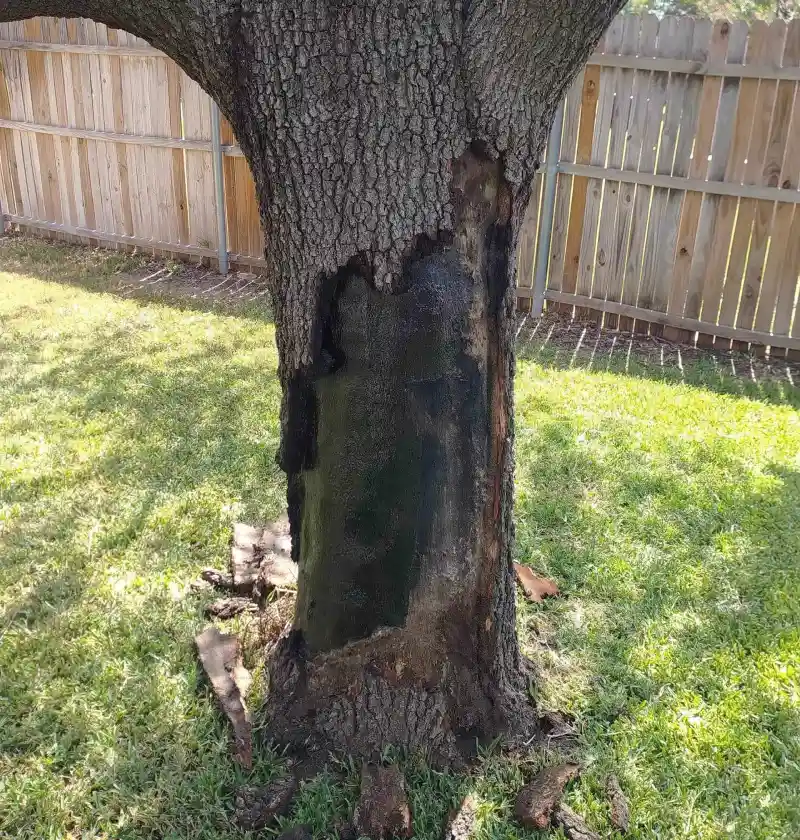
Cracks in the main trunk or at large branch junctions (“unions”) mean the tree’s structural strength is compromised. We have seen even small cracks widen rapidly after storms or sudden temperature changes. V-shaped unions are weaker than U-shaped ones, and including bark makes splits more likely.
It’s wise to watch these areas, especially on native oaks, elms, or pecans, which are common across Fort Worth. Cracks that go deep into the heartwood or extend across most of the trunk are a red flag for imminent failure.
3. Mushrooms or Decay at the Base
Wood rot fungi, including shelf mushrooms (conks), signal that decay is breaking down core wood near the roots. In North Texas, Ganoderma and Laetiporus (“Chicken of the Woods”) are both common. Decay is not always visible; sometimes the tree looks healthy up top while the base breaks down.
Probe soft spots at the trunk flare with a screwdriver or similar tool. If you sink several inches with little resistance, internal decay may be severe. Decay at the root flare is a key reason for tree removal because tree stability is reduced.
| In Short: Fungi at the base aren’t just growing on the tree, they’re consuming it. By the time mushrooms appear on the outside, internal decay may already be extensive. What you see on the surface is almost always just the tip of the problem. |
4. Significant Lean or Soil Heaving
A tree that suddenly leans more than 15 degrees deserves immediate attention. Shifting soil, exposed roots, or “heaving” (where the ground lifts around one side of the trunk) often appear after weeks of rain or high winds. Experiencing drought followed by rain, which is common in many parts of Texas, can loosen already dry, compacted soil and increase risk.
Observe changes in lean or soil levels after storms. Never ignore new tilting near buildings, homes, or play areas, especially with large native species such as cottonwood or hackberry.
5. Visible Root Damage or Bare Roots
Roots are the tree’s anchor, and any damage can destabilize the whole tree. Construction, mowing, trenching, or nearby paving all wound roots. In some Fort Worth neighborhoods, roots are easy to see when the soil shifts or erodes.
Check for exposed, severed, or rotting roots, especially on the side facing prevailing winds. If you notice mushrooms growing from large roots, that is a sign of root disease. Girdling roots, which wrap around the trunk instead of growing outward, also decrease stability.
| Tip: If construction or trenching is planned within 10 metres of a mature tree, consult an arborist before work begins. Root damage often doesn’t show up as canopy decline until one to three years later, by which point the tree may already be structurally compromised. |
6. Canopy Dieback and Sparse Leaf Growth
If the upper or outer branches show leaf loss or sparse foliage well before autumn, suspect health decline. Chronic drought, oak wilt, and insect infestations all cause this pattern locally. Compare your tree’s leaf density with nearby healthy trees of the same species.
Use a pair of binoculars to spot twig or small branch dieback high up. Branches with no leaves but present during the last growing season point to ongoing decline. Take time every spring and early fall to assess tree health from different angles.
7. Signs of Insect Infestation or Disease
Locally, emerald ash borer and oak wilt cause sudden dieback. Small holes, sawdust piles, or dark streaks in bark are warning signs. In live oaks and red oaks, leaf discoloration, sudden leaf drop, or fungal mats near the base need fast action. Woodpecker activity on otherwise healthy trees often points to a hidden pest issue.
If you spot bark beetles, webbing, or other insect activity, review the tree’s overall condition and act as needed. Early pest detection is the most important thing to prevent widespread tree loss.
| Pest / Disease | Warning Signs | Trees at Risk |
| Emerald ash borer | D-shaped exit holes, S-shaped galleries under bark | Ash species |
| Oak wilt | Rapid leaf drop, veinal necrosis, fungal mats | Live oak, red oak |
| Bark beetles | Small round holes, sawdust (frass) at trunk | Stressed oaks, pines |
| Hypoxylon canker | Powdery tan/brown crust on bark | Oaks under drought stress |
| Fact: The emerald ash borer has been confirmed in multiple Texas counties. It kills ash trees by disrupting the flow of water and nutrients beneath the bark. There is no cure once infestation is advanced, early detection is the only effective defence. |
Assessing Tree Risk: What to Do Next
Spotting these warning signs does not always mean you need immediate tree removal. However, it does mean you should investigate and plan. Begin by noting the location, size, and structure of the tree. Consider what could be hit if part or all of the tree fell, including homes, cars, fences, or public sidewalks. Focus on trees close to high-traffic areas or essential structures.
Keep written or photo records. Mark changes and compare over time. For major cracks, decay, or obvious instability, restrict access underneath the tree until you get a professional assessment. At Fort Worth Arborist Co., we offer emergency tree care services, including a quick assessment to see if you need removal immediately.
| Tip: When you call an arborist, have your photos ready and note when you first noticed each warning sign. The more history you can provide, the more accurately they can assess the rate of decline and urgency. |
Practical Steps for Homeowners and Property Managers
You don’t have to be a certified arborist to stay on top of your trees. You just need to know what to look for and when to ask for help. A little routine attention goes a long way toward keeping your property safe and landscape healthy.
Here’s where to start:
- Walk your property seasonally, especially after storms, heavy winds, or extended drought, when trees are most vulnerable to hidden damage.
- Clear away vines and brush around the trunk base so you can actually see what’s going on, because overgrowth is one of the easiest ways to miss early warning signs.
- Tap lower branches with a pole or broom handle and listen carefully. Typically, hollow or dull “punky” sounds can be a telltale sign of internal decay.
- Take photos and track changes over time. A new lean, a spreading crack, or thinning leaves that weren’t there last season are all worth documenting.
- Check the root zone for soft spots or mushrooms. If you see fungi growing at the base or along surface roots, they often signal rot that’s working from the ground up.
- Keep the area under a suspect tree clear. If you’re seeing red flags, limit foot traffic beneath it until you get a professional opinion.
- When in doubt, call a local ISA Certified Arborist like us. Whether it’s advanced diagnostic testing, a formal risk assessment, or guidance on tree removal, a certified pro gives you the facts you need to make a confident decision.
Stay Ahead of Tree Hazards
Trees can stand for decades with the right care, but weather, pests, and old injuries catch up to even the healthiest oaks and elms on your property in Fort Worth. You should always watch for small changes, respect your own concerns, and never ignore new warning signs. Being proactive keeps you, your family, tenants, or customers safer and helps preserve the tree canopy.
If you suspect your tree may be dangerous, now is the time to act. Call (817) 975 0180 or fill out our online form to schedule an inspection with the help of our experts.
Frequently Asked Questions (FAQs)
1. How do I know if a tree is actually dangerous or just looks rough?
A tree can look rough and still be structurally sound, or it can look totally fine and be rotting from the inside. The indicators are things like cracks in the trunk, fungal growth at the base, sudden leaning, and dead branches overhead. When in doubt, a certified arborist can give you a definitive answer.
2. Can a leaning tree be saved, or does it always need to come down?
It depends on how much the tree is leaning, how long it’s been that way, and what’s causing it. A tree that’s always grown at a slight angle is very different from one that shifted suddenly after a storm. An arborist can assess the root system and structural integrity to help you decide.
3. How often should I have my trees professionally inspected?
For most homeowners, once a year is a solid baseline, ideally in spring when new growth makes problems easier to spot. If you’ve recently had a major storm, drought, or construction work near your trees, it’s worth scheduling an inspection sooner rather than later.
4. My tree has mushrooms growing at the base. Is it definitely dying?
Not necessarily, but it’s a warning sign that shouldn’t be ignored. Fungal growth near the root flare usually means internal decay is present. The extent of the damage determines the next step. Sometimes treatment can help, but in many cases, removal is the safer option.
5. Is it safe to remove a dangerous tree myself?
We strongly advise against it. Tree removal, especially when a tree is already structurally compromised, is one of the most hazardous jobs in landscaping. Without the right equipment, training, and insurance, the risks to you, your property, and your neighbors are significant. Always hire a licensed, insured arborist.
6. What’s the difference between a dead branch and a dormant one?
A dormant branch will still have buds and some flexibility. It’s just resting for the season. A dead branch is brittle, gray or white in color, has no buds, and may have loose or missing bark. If you scratch the surface and see green underneath, it’s likely still alive.
7. Will my homeowner’s insurance cover damage from a fallen tree?
It depends on your policy and the circumstances. If a healthy tree falls due to a storm, most standard policies cover the damage to structures. However, if a tree was visibly diseased or hazardous and you didn’t address it, your claim could be denied. Keeping records of inspections and any professional assessments can protect you significantly.